One of the best things about coming to visit Ireland is getting to know the culture. Once you grow fond of Ireland and its people - it's hard to leave. We'd love to have you back for another visit anytime.
Etiquette in Ireland
There are a few etiquette rules to keep in mind when visiting Ireland. The majority of these are based around good manners, such as holding the door open for the person behind you, giving a wave to a passing car if they have given you the right of way and asking people in a pub if the empty seat near them is being used, before taking it.
What's a round in the pub, and how does it work?
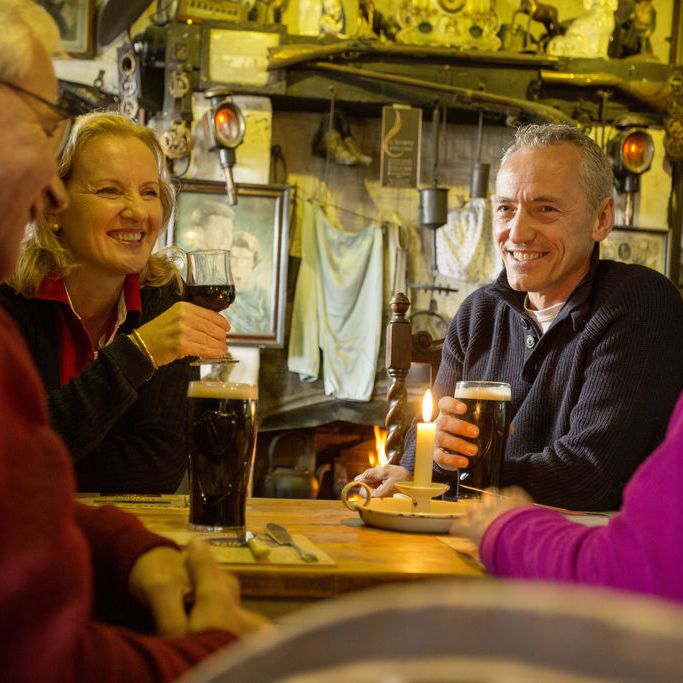
Drinking in rounds is also not a rule but it is pretty much standard procedure. The easiest way to describe it is to imagine two guys going to a local pub. For the sake of this story, let's call them John and Mike. John takes a seat in the pub, Mike goes up to the bar and buys his own drink and John's drink. Mike returns with the 2 drinks, they drink their drinks and now it's John's turn to go up to the bar and buy the same 2 drinks... and so on and so on.
James Walsh: "The absolute 'golden rule' is to never duck out when you know you are next in the round. If you're unsure or it's getting complicated, just ask 'Is it my round?' — people are always happy to explain how it's working." Read more about pub culture in Ireland.
Irish Culture, Customs & Quirks
The psychology of being Irish
It is said that the neurologist Sigmund Freud once referred to the Irish as "the only race of people for whom psychoanalysis is of no use".
Some suggest it was not Freud himself, but one of his followers who believed that the Irish, when faced with inner turmoil, seek refuge in poetry, storytelling, or escapism rather than digging into their minds for solutions. cpja.org.uk
I'm not ashamed to say that I do actually write poetry in times of trouble. I find it incredibly therapeutic. So perhaps there is some truth in this statement after all.
There is a stoicism in being Irish, we are both strong perhaps harsh seeming - yet also incredibly empathetic and helpful. This is most likely due to our history from the famine years, the occupation of Ireland, the fight for a republic and the subsequent troubles in Northern Ireland. There is a lot of pain in Irish history but the story telling from those times of hardship always reminds us of a resiliant and caring community. Even in the hardest of times, neighbour helped neighbour. To this day Irish people will not see you go hungry, or thirsty (hence the importance of the offer of tea!) - or without company and a sympathetic ear.
Tea is life in Ireland.
Everybody in Ireland drinks tea. Tea is the lifeblood of Ireland. Tea is not a choice, tea is a way of life. I'm having a cup of tea as I write this, I had a cup of tea with my breakfast and there is a good chance I will have a cup of tea later.
By asking for it in a very specific way (amount of milk and/or sugar preference), and complimenting the result, you'll have made the tea makers day.
The breakfast (or all day!) fry-up in Ireland
The Fry-Up is up there with Tea in terms of its popularity with Irish people. The 'Fry-Up', or simply the 'Fry', or to give it its proper name the 'Full Irish Breakfast' consists of pork sausages, pork rashers, fried eggs, black pudding (made from pork blood, pork fat and cereal) and white pudding (the same as the black pudding but does not contain blood), baked beans, toast and, you guessed it... a massive serving of tea!
Talking about the weather in Ireland
It's very true that everyone in Ireland loves talking, chatting, catching up, usually over a cup of tea! If you listen closely, you will come to realise that it's not so much that we love talking, rather we love talking about the weather.
There may be a bit of padding on either end of the conversations but what remains is entirely about the weather. While telling a story and setting a scene, it's almost a prerequisite to start with how the weather was... even if the story takes place indoors, you can still mention something about the temperature. This will set the Irish mind at ease and you can continue on, uninterrupted, with your story. If the weather is good, you say: 'Tis grand' If the weather is bad, you say: 'Ah, it'll be grand, throw on a warm coat!'.
What does 'grand' mean in Ireland?
To the outsider, the word's meaning can become confusing as it is used to express joy (grand!), sadness (ah, grand), sarcasm (oh, that's grand!), hope (ah, it'll be grand). It's a word that can get you out of, or into, any situation in Ireland.